
How Long Does It Take to Build a Timber Frame Home
If you're asking how long it takes to build a timber frame home, you've probably already gotten three different answers. Six months. Two years. "Well, it depends."
That's frustrating when you're trying to plan a move, a construction loan, or the start of a school year around it.
The short answer is this. Most custom timber frame homes take 12 to 18 months from your first design conversation to the day you move in. Most of that time goes to things that have nothing to do with the frame itself.
Tuscarora Timber Frame has spent more than 18 years designing and crafting custom timber frames in Newburg, Pennsylvania, and shipping them to builders and homeowners across the country. We don't run the whole build. Your general contractor does that. But we've watched a lot of these schedules play out, and we know where the months actually go.
Below is an honest, stage-by-stage breakdown so you can plan around real numbers instead of guessing.
TL;DR - How Long Does It Take to Build a Timber Frame Home
Don't have time to read the whole post? Here's the short version.
- Most custom timber frame homes take 12 to 18 months from the first design conversation to move-in day.
- Design and drawings take longer than people expect, usually 2 to 4 months.
- Fabrication and delivery of your frame run 8 to 16 weeks once plans are final.
- The frame itself is raised in days, not weeks, because it arrives pre-cut and numbered.
- The longest stretch is enclosure and interior finish, which runs 4 to 8 months and is done by your builder.
- Homes in the Middle Atlantic averaged 13.7 months in 2024, while the South Atlantic averaged 7.8.
- Timber framing speeds up the framing stage. It does not shorten the finish work.
What the Numbers Say About Building Any Custom Home
Before we get into timber specifics, it helps to see the baseline for every new home.
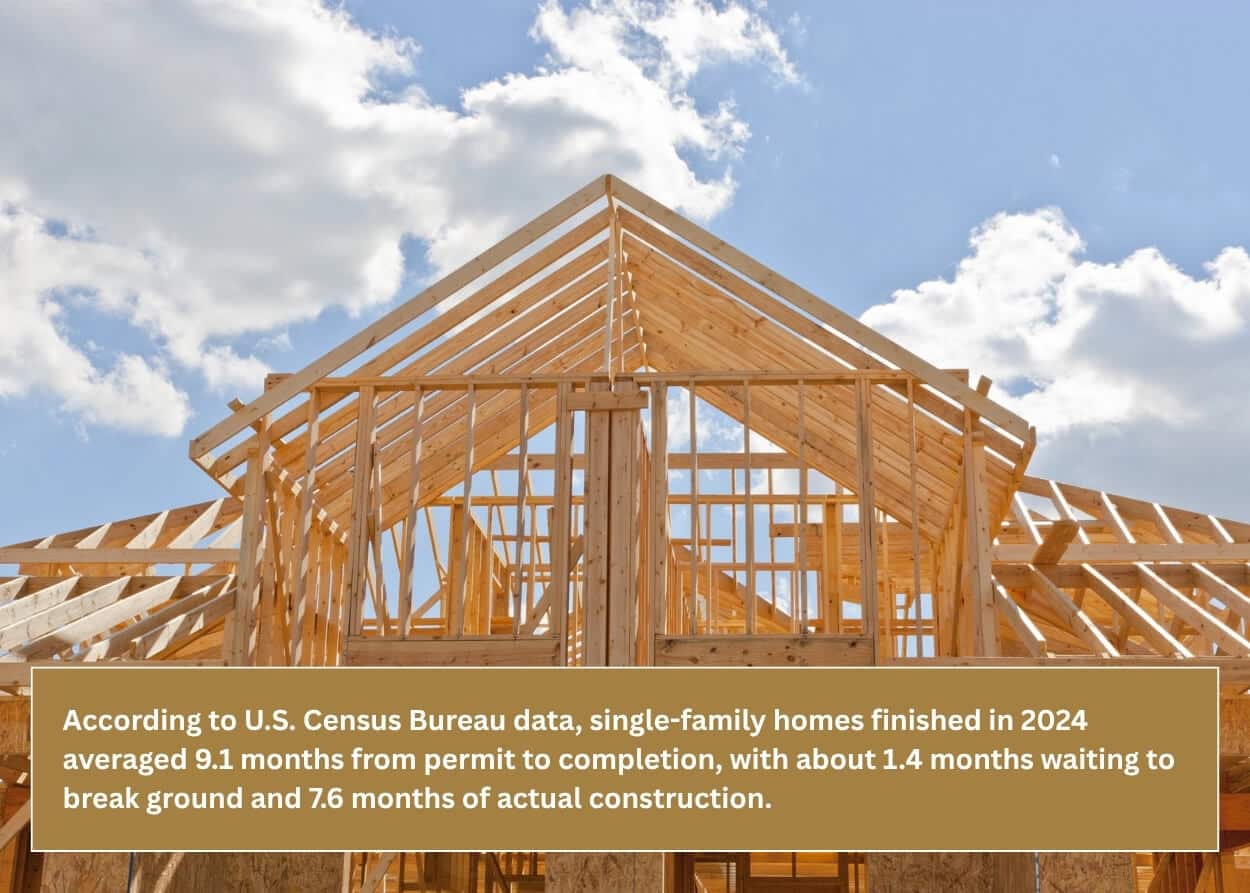
The U.S. Census Bureau tracks how long homes take from permit to completion. Based on that data, single-family homes finished in 2024 averaged 9.1 months from authorization to completion. That splits into roughly 1.4 months waiting to break ground and 7.6 months of actual construction.
Two details matter a lot for our readers:
- Where you build changes everything. The Middle Atlantic division, which includes Pennsylvania, averaged 13.7 months. New England averaged 13.1 months. The South Atlantic, which includes Virginia, was the fastest region in the country at 7.8 months.
- Square footage adds months. Homes between 4,000 and 4,999 square feet averaged 10.7 months. Homes between 5,000 and 5,999 averaged about 14 months. Homes over 6,000 square feet took nearly 16 months.
Keep in mind those are averages across all new homes, including production builds using the same floor plan over and over. A one-of-a-kind timber frame home sits at the longer end of the range. 12 to 18 months is a fair window to plan around.
6 Stages of a Timber Frame Home Build
Every timber frame home timeline breaks into the same 6 stages. Once you know how long each one takes, the whole project stops feeling like a mystery.
- Design and drawings: 2 to 4 months
This is the stage people underestimate most. Floor plans, frame layout, engineering input, and revisions all happen here. We build a 3D model you can spin, review, and change before a single timber gets cut. Every change you make at this stage costs you nothing. Changes made later cost real money and time.
- Permits and approvals: 1 to 3 months
This one varies more by zip code than by anything else. Loudoun County, Virginia publishes a live residential permit dashboard, and it shows that most residential applications wait up to ten business days just to be checked for completeness, before review even starts. Rural Pennsylvania townships often move faster. And in Loudoun County, some properties need extra approvals on top of the building permit, including a grading permit for steep slopes and a health permit if you're on a well or septic. Historic district review, where it applies, adds even more time.
- Frame fabrication and delivery: generally 8 to 16 weeks after your plans are final
This is the stage where your home stops being a drawing. We select the timbers, cut every joint, dry-fit the connections in our shop, and apply the finish you chose. We number every piece before it ships.
Two things about this stage surprise people:
- The clock starts when your plans are final, not when you first call us. Each round of revisions pushes the start date back.
- It runs at the same time as your site work. Your foundation crew and our shop work in parallel, so you aren't waiting through both one after the other. Fabrication usually takes longer than site work, though, which means it's often the stage that sets your pace.
Where your project lands in that 8 to 16 week window depends on size and complexity. Send us your plans, and we'll give you a date in writing before you commit to anything.
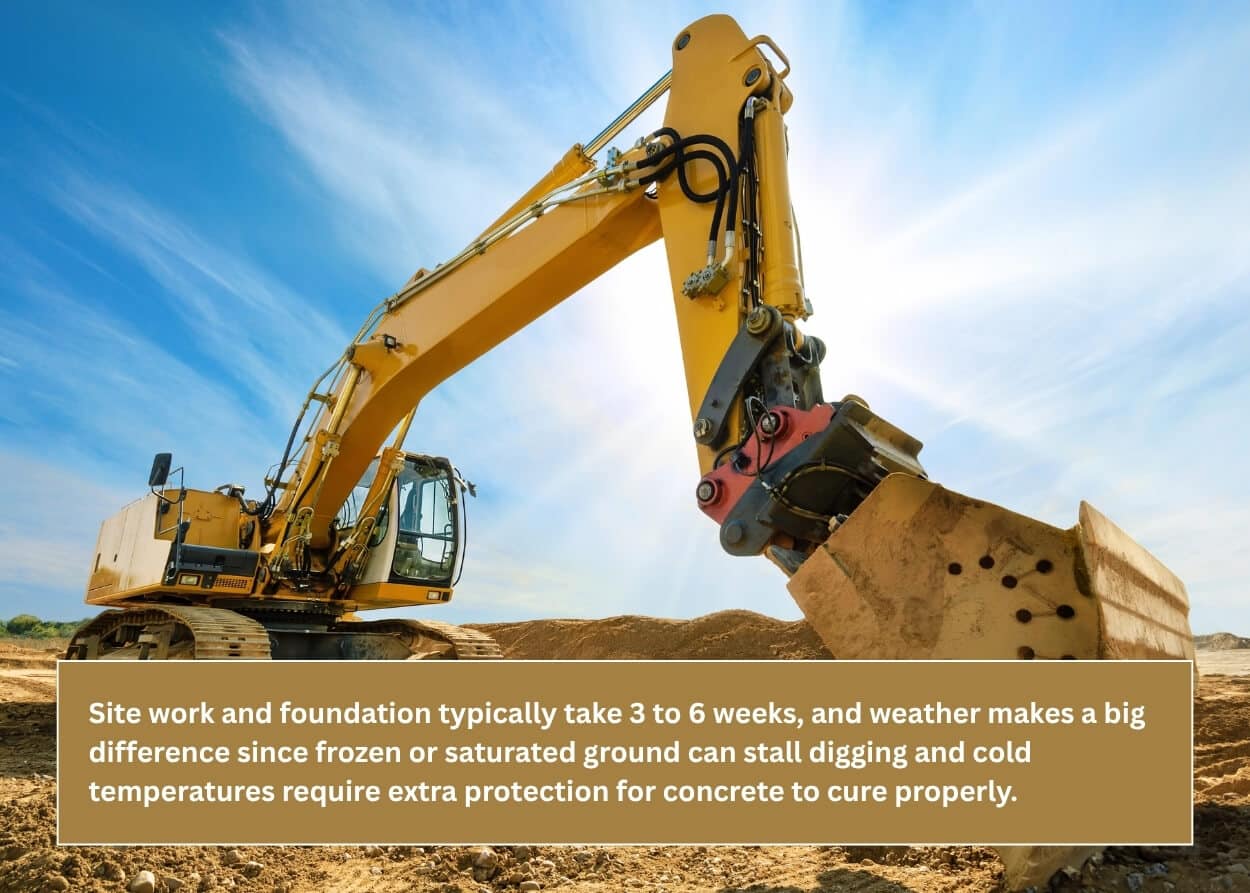
- Site work and foundation: 3 to 6 weeks
Excavation, footers, foundation, and backfill. Weather makes a big difference in this stage. Frozen or saturated ground can stall digging, and once temperatures drop below 40 degrees, concrete needs extra heat and protection to cure properly, which adds time and cost.
- Frame raising: a few days to 2 weeks
Your frame arrives pre-cut, numbered, and ready to assemble. With the drawings and numbered parts in hand, it’s a straightforward process for a crew to raise a home frame quickly, with far less standing around and guessing what goes where.
- Enclosure and interior finish: 4 to 8 months
Roof, walls, windows, insulation, plumbing, wiring, drywall, floors, cabinets, and trim. This is the longest stretch of the whole project, and is in the hands of your builder.
Does a Timber Frame Actually Build Faster?
Yes and no, and the difference is worth understanding before you sign anything.
The frame goes up fast. Because we cut the joinery in our shop and every piece arrives numbered, the framing goes up in days instead of weeks. This means fewer crew hours on site, fewer surprises, and fewer callbacks to fix something that didn't fit.
What a timber frame doesn't do is shrink the back half of your project. Mechanicals, finishes, and inspections take the same time they would in any custom home.
So the accurate claim is this: timber framing shortens the framing stage and reduces problems in the field. What comes after is still within most conventional timeframes for building a home. It doesn't turn an 18-month home into a 9-month home. Anyone who promises that is setting you up for frustration later.
3 Things That Keep a Build on Schedule
Some of this timeline is out of your hands. These three are not.
- Settle your floor plan before engineering starts.
- Apply for permits as soon as your plans are final.
- Introduce your builder and your frame supplier early.
Where We Fit in Your Timeline
We design and craft the frame. Your builder handles the site, the enclosure, and the finish work.
You get a 3D design to review and adjust before anything is cut, plus CAD drawings, a numbered materials list, and detailed assembly drawings that make installation straightforward. We ship pre-finished timber frame kits across the United States from our shop in the Tuscarora Valley, so your location isn't a problem.
Distance isn't what slows projects down. Long lead times are. Ask us for a date, and you'll get one.
Your Next 3 Steps
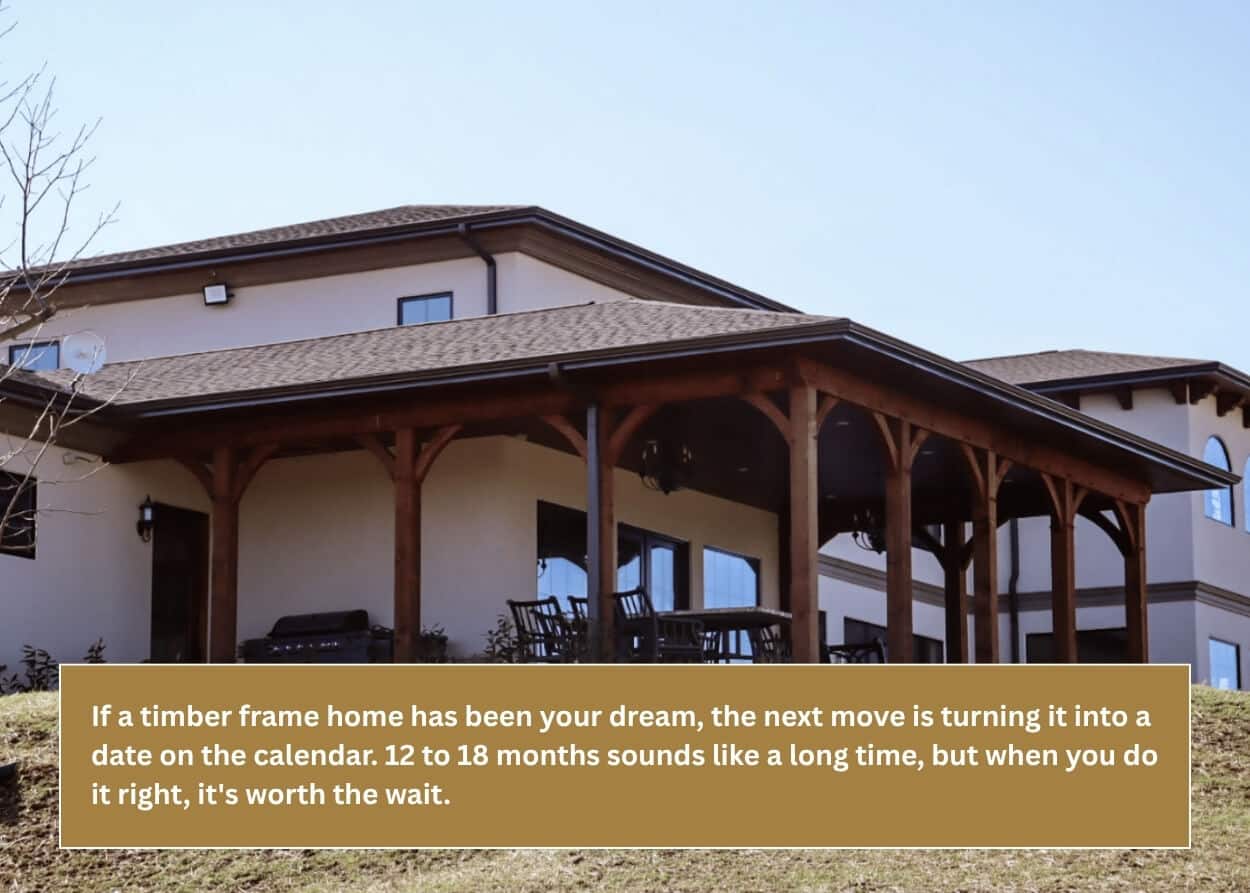
If a timber frame home has been your dream, the next move is turning it into a date on the calendar. 12 to 18 months sounds like a long time, but when you do it right, it's worth the wait.
Here's where to start:
- Write down your must-haves. Square footage, roof style, and the rooms you can't live without.
- Ask your builder for their site schedule and permit timeline for your county.
- Send us your plans or even a rough sketch.
Tell us about your project, and we'll come back with a timeline built around your plans, not a generic estimate. You can also reach us at (717) 844-5111.
Want to go deeper? How Timber Frame Homes Are Built walks through what happens in the shop, from lumber selection to raising day, and The Enduring Allure of Timber Frame Homes covers 10 reasons people choose timber over stick framing in the first place.